
Envisioning a greener future for the Pharmaceutical industry through AI-powered supply chain management technologies
Abstract
The pharmaceutical industry is rapidly turning to AI/machine learning integrated digital twin technologies to address end-to-end inefficiencies within temperature-sensitive supply chains. Supply chain digital twin models provide near real-time supply chain visibility and predictive insights, enabling pharmaceutical companies to optimize logistics, greenhouse gas reporting, manufacturing processes, and risk management. As showcased by case studies presented by leaders like Boehringer Ingelheim, Octapharma, and GSK in the AUTOMA+ 2025 Congress, digital twins are transforming sustainability from a compliance challenge into a strategic advantage in the pharmaceutical industry. These efforts highlight how AI-driven supply chain management is paving the way for a smarter, greener pharmaceutical future that can more effectively deliver life-saving treatments and cost savings within pharmaceutical supply chains.
Introduction
The 5th Pharmaceutical Automation and Digitalisation Congress (AUTOMA+ 2025) will take place in Vösendorf, Austria, later this month. Bringing together over 290 industry leaders, the conference will focus on how digital supply chain management (SCM) technologies promise to revolutionize pharmaceutical value chains. This raises the question: What are the benefits of incorporating integrated SCM technologies within the pharmaceutical industry?
Pharmaceutical companies depend on complex global networks of raw material suppliers, packaging producers, contract manufacturers, and distributors. The temperature-regulated “cold chains” required to safely transport and store vaccines, biologics, and other temperature-sensitive drugs contribute to the complexity of pharmaceutical supply chains. If parts of the system fail, doses spoil. The 2019 Biopharma Cold Chain Logistics Survey highlighted significant financial losses within pharmaceutical supply chains–estimating losses of $35 billion annually–due to temperature control failures, international shipping, and gaps in real-time monitoring of humidity (Peli BioThermal 2019). This staggering figure also represents enormous hidden emissions from discarded products and redundant operations. Carbon-intensive cold chains are estimated to account for 4% of global GHG emissions (Lin et al., 2025). These losses are emblematic of a larger issue within the pharmaceutical industry: an ignorance-is-bliss approach among high-level financial decision-makers when it comes to issues of climate change and emissions. Today, climate change, tightening sustainability frameworks like the EU’s Corporate Sustainability Reporting Directive (CSRD), and unpredictable weather externalities are starting to forcibly reshape this approach. Major pharmaceutical companies largely report their emissions, with many even incorporating corporate sustainability into their procurement levers.
McKinsey estimates that roughly 75% of emissions across pharmaceutical value chains reside in Scope 3 emissions (Fernandez & Pérez, 2023). Corporations categorize their emissions based on Scope 1, 2, and 3 emission standards set by the GHG protocol. Scope 1 encompasses direct emissions from a company’s owned assets (i.e., company fleets), Scope 2 encompasses indirect emissions from purchased energy (i.e., solar), and Scope 3 encompasses a company's entire value chain (i.e., supplier emissions, etc.). Effective industrial decarbonization aims for Scope 3 emissions reductions because these upstream and downstream activities typically represent the vast majority of an organization's total emissions. Reducing emissions requires unprecedented visibility into how and which materials move through complex, opaque supply chains. That’s precisely where AI-powered digital twins tools come in.
Digital Twins in Pharmaceutical Supply Chains
Coupa defines a digital twin as a “virtual representation of a physical object, system, or process” (Coupa Editorial Team, 2024). There are two general types of digital twins (see Figure 1 below). First, there are product digital twins, which test a product’s performance under different scenarios and improve its design and lifecycle (i.e., vaccine manufacturing), and second, there are control tower digital twins, which optimize an entire system or network efficiency by testing its reaction to different disruptions and stressors (i.e., supply chain bottlenecks)
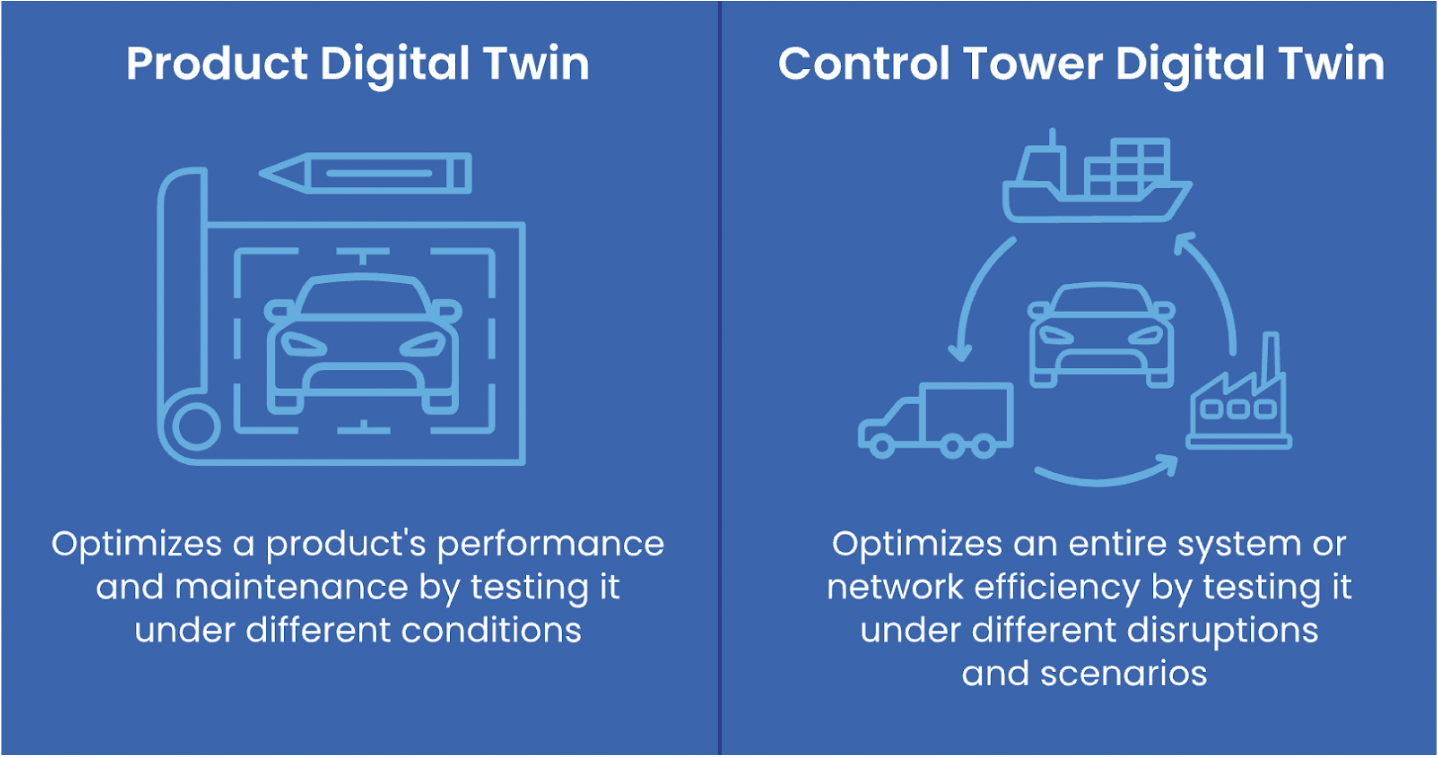
Figure 1: Reproduction of Coupa’s Visual Representation of Product and Control Tower Digital Twins (Coupa Editorial Team 2024).
A supply chain digital twin is a type of control tower that incorporates nearly real-time data, such as “ERP data, factory outputs, node lanes, inventory levels, vehicle locations, shipment schedules, market dynamics” into supply chain management systems (Coupa Editorial Team, 2024). Using these data, the model helps procurement teams uncover bottlenecks, monitor risks, and inform long-term financial decisions. Utilizing digital twin technologies can bridge macro (procurement) and micro (finance) supply chain dynamics that increase functional resiliency and efficiency within pharmaceutical supply chains.
Regarding sustainability, digital twins run life cycle assessments (LCA) across product portfolios–quantifying emissions from every supplier, transport leg, and manufacturing input. Next, they model alternative procurement and logistics scenarios, ranking options based on carbon impact and cost. AI-powered cold chain technologies create a new kind of procurement intelligence: one that treats sustainability metrics as first-class business KPIs. Instead of reactive carbon accounting once a year, AI enables continuous optimization and a way for companies to get closer to their climate targets.
In the upcoming AUTOMA+ conference, Joachim Bär, the Director of DevOps at Boehringer Ingelheim, will lead a workshop demonstrating digital twins' promises in the pharmaceutical industry. Firstly, the team will demonstrate Boehringer Ingelheim’s success using the technologies to mirror complex biomanufacturing operations, optimize facility utilization, identify bottlenecks, perform gap assessments, and ultimately unlock efficiency and sustainability gains. Similarly, representatives from Octapharma and GSK will present case studies displaying the success of AI/machine learning tools in producing savings and emissions reductions across their corporate value chains.
Conclusion
While Generative AI has been sitting at the forefront of the national psyche since ChatGPT’s 2022 breakout, digital twins have silently laid the foundation for another globally dominant AI-backed industry that transforms enterprise as it is known. (Deshpande, 2024). BCC Research predicts the Global Digital Twin Market will soar from $18.2 billion in 2024 to $119.3 billion by the end of 2029, at a compound annual growth rate of 45.7%. (BCC Research, 2024). As digital twin technologies emerge as a solution to supply chain management, sustainability ceases to be a compliance burden and becomes a core business function—one that drives profitability, innovation, and trust. In the pharmaceutical sector, an industry where precision can mean the difference between life and death, it’s only fitting that the next great innovation in pharmaceutical science may not be a new drug at all—but a smarter, greener way to deliver it.
Works cited
“2019 Biopharma Cold Chain Logistics Survey Report.” n.d. Accessed November 9, 2025. https://info.pelicanbiothermal.com/2019tcpsurveyreportpeli-lp-0.
“Accelerating the Transition to Net Zero in Life Sciences | McKinsey.” n.d. Accessed November 10, 2025. https://www.mckinsey.com/industries/life-sciences/our-insights/accelerating-the-transition-to-net-zero-in-life-sciences.
“Digital Twins and Generative AI: A Powerful Pairing | McKinsey & Company.” n.d. Accessed November 10, 2025. https://www.mckinsey.com/capabilities/tech-and-ai/our-insights/tech-forward/digital-twins-and-generative-ai-a-powerful-pairing.
“Digital Twins and the Enterprise Metaverse | McKinsey.” n.d. Accessed November 10, 2025. https://www.mckinsey.com/capabilities/tech-and-ai/our-insights/digital-twins-the-foundation-of-the-enterprise-metaverse.
“Global Digital Twin Market.” n.d. Accessed November 10, 2025. https://www.bccresearch.com/pressroom/eng/global-digital-twin-market?srsltid=AfmBOop98iJEFHRhuc4jBFHX6kLTY3QJFmEto2TKVNVAl6zP7MsufwHd.
India|authorurl:https://www.ey.com/en_in/people/ram-deshpande, authorsalutation: |authorfirstname:Ram|authorlastname:Deshpande|authorjobtitle:Partner, Technology Consulting, EY. n.d. “Tech Trend 04: Digital Twins: Creating Intelligent Industries.” Accessed November 10, 2025. https://www.ey.com/en_in/insights/technology/digital-twins-creating-intelligent-industries.
Lin, Hung-Jui, Pei-Ci Chen, Hsuan-Po Lin, and I-Yun Lisa Hsieh. 2025. “Quantifying Carbon Emissions in Cold Chain Transport: A Real-World Data-Driven Approach.” Transportation Research Part D: Transport and Environment 142 (May): 104679. https://doi.org/10.1016/j.trd.2025.104679.
Longworth, Catherine. 2025. “Next‑Gen Pharma: AI, ML & Digital Twins Converge at AUTOMA+ 2025.” Pharmaceutical Technology, May 20. https://www.pharmaceutical-technology.com/sponsored/next‑gen-pharma-ai-ml-digital-twins-converge-at-automa-2025/.
MarketsandMarkets. n.d. “Digital Twin Market Size, Share, Industry Trends Report 2030.” Accessed November 10, 2025. https://www.marketsandmarkets.com/Market-Reports/digital-twin-market-225269522.html.
Team, Coupa Editorial. 2024. “The Complete Guide to Supply Chain Digital Twins.” Coupa, August 23. https://www.coupa.com/blog/the-complete-guide-to-supply-chain-digital-twins/.
US EPA, OAR. 2016. “Scope 3 Inventory Guidance.” Overviews and Factsheets. November 8. https://www.epa.gov/climateleadership/scope-3-inventory-guidance.